Life on My Knees · The Tile Guy Diaries · Entry 2
Mosaic is my therapy.
Making art with an ADHD brain. People ask how I can spend hours — days — placing tiny pieces one at a time without going mad. Honestly? It's the only time my brain goes quiet.
Forty tabs open
I have ADHD. Most of the day my head is forty tabs open at once: jobs, quotes, materials, the van, the next client, the last client. It's loud in there. There's always a tab refreshing itself, always something half-finished buzzing at the edge of my attention. Anyone who runs a one-man business knows the noise; my brain just turns the volume up and loses the remote.
But put me at the bench with a board, a pile of cut glass and stone, and a picture forming one piece at a time, and the tabs close. One piece. Then the next. There's no shortcut to think about, no notification that matters. Just the piece in my hand and where it belongs.
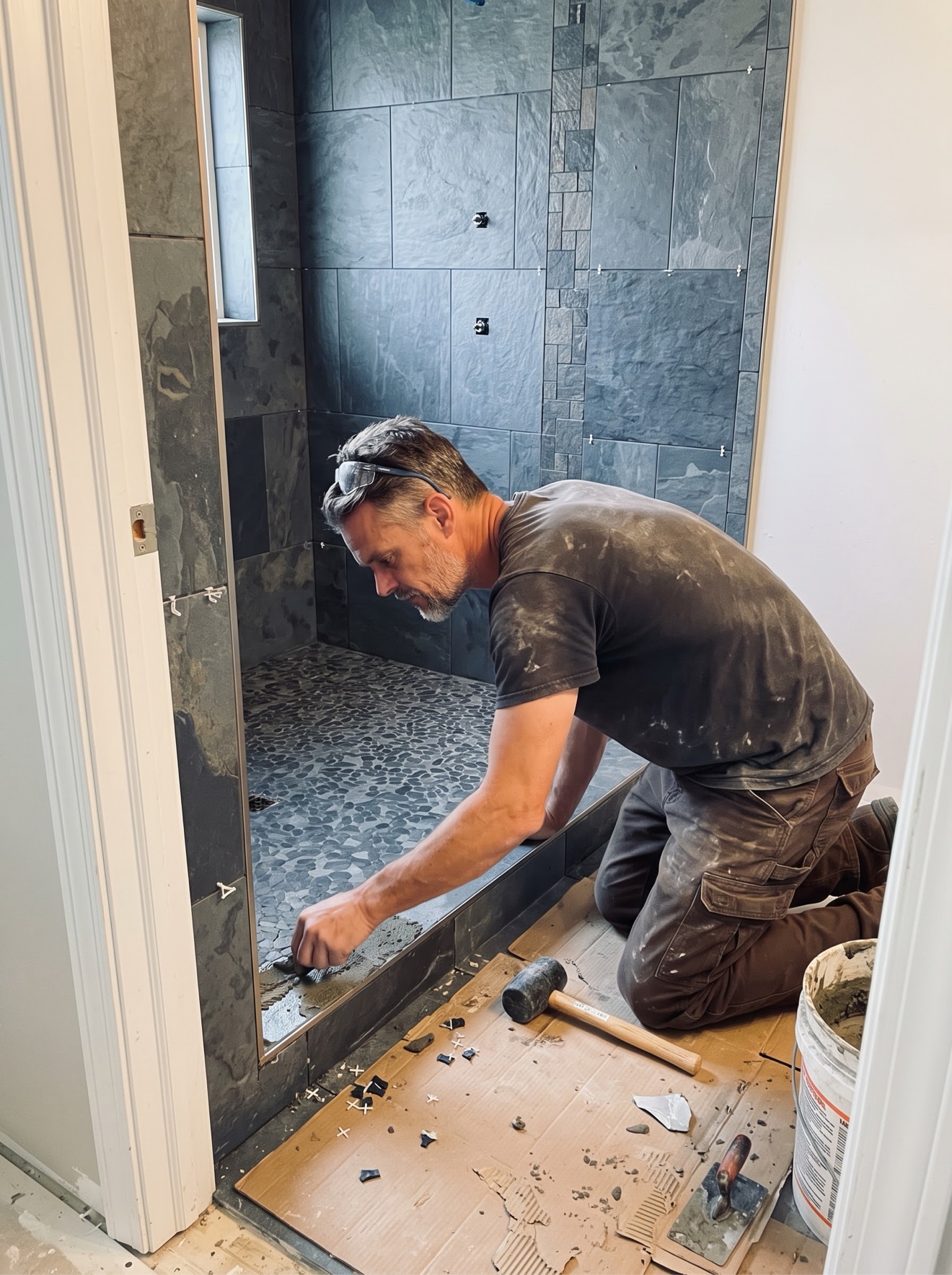
It isn't only studio work that does it, either. It's the same on the tools. Hand-setting a pebble shower floor, one stone at a time, feeling each one sit right under your fingers — that's hundreds of tiny decisions, each one small enough to hold my whole attention, and nothing else gets a look-in. The day job and the art run on the same engine. Piece, piece, piece. Quiet.
The work forces the focus
That's the thing nobody tells you about mosaic: it can't be rushed, and it can't be half-attended. Try to hurry it and the lines wander. Try to think about something else and your hand puts the wrong colour in the wrong place, and you feel it before you see it. The work forces the focus that my brain doesn't give me for free — and rewards it. An hour disappears. My shoulders drop. It's not a break from my brain; it's my brain finally doing the thing it's built for.
ADHD comes with hyperfocus, and hyperfocus aimed at a mosaic is a superpower: patterns, colour shifts, the tiny problem of a curve that won't sit right — I can live inside those details longer than most people would tolerate. The same head that can't sit still through paperwork will happily spend a day coaxing a gradient of glass from dark to light, one sliver at a time, and come up for air wondering where the light went.
The bench
There's a ritual to it, and the ritual is half the medicine. The board goes down. The pieces come out — cut glass, stone, whatever the picture wants — and get sorted before a single one is placed: colours in their piles, the odd-shaped bits separated from the regulars, the whole image existing first as a sort of organised mess. From the outside it must look like the slowest way imaginable to make a picture. From the inside, it's the only speed there is. Each piece gets picked up, turned over, tried against its neighbours, and either it belongs or it doesn't. There's no committee. There's no debate. The piece knows, and once you've done it long enough, so do you.
People imagine the hard part is the cutting, or the grouting at the end. It isn't. The hard part — the good part — is the thousand small judgements in between, each one too small to argue with and too important to skip. A loud brain doesn't stand a chance against that. There's simply no room left in the room.
What the trade taught me, what mosaic taught me
Twenty-six years in tile taught me the trade. Mosaic taught me patience with myself.
The tile work came first, and it matters that it did. A shower doesn't care about your feelings; it cares about falls, waterproofing and lines. That discipline — prep properly, mind your lines, no shortcuts under grout — is the floor everything else stands on. But discipline alone makes for a hard head and a loud one. The mosaics are where the same hands do something slower and stranger, where the picture is in my head before it's on the board and the job is just closing the distance between the two, one piece at a time.
It's also why I split the work in two when I came back to the trade: the remodeling on one side, the mosaics — the Lion & Crown side of my life — on the other. Two kinds of work, two kinds of quiet. This entry isn't a pitch for either of them. It's just the honest answer to the question I get asked most: how do you not go mad doing that?
The truthful answer is that the pieces are what stop me going mad.
One piece at a time
When a mosaic leaves my bench, whatever it ends up being — a wall piece, a mural, a feature in somebody's shower — it's the calmest, most focused version of me, set in grout. Most days in there don't feel like work. They feel like therapy that happens to leave something beautiful behind.
If your brain is loud too — whatever your craft is, find the thing that makes you place one piece at a time. A bench, a garden, an engine in bits on a cloth. Doesn't matter what it is. It works.
— Simon Beames
That's the life. The work's the rest of the site.
Stories live here in the diary. The remodeling — bathrooms, tile, flooring, handyman — lives on the other pages, if that's what you came for.